
National scene: the urgent debate on accessibility to theater in Brazil
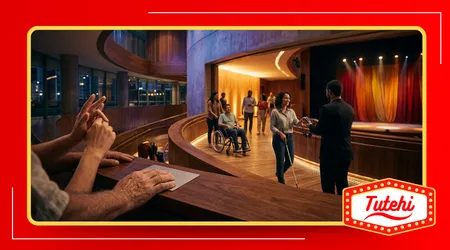
THE debate on accessibility In the Brazilian theatrical scene, inclusion reached a level of urgency in 2026, driven by new federal regulations and social pressure that no longer accepts it as a mere footnote.
Advertisement
This discussion goes beyond the concrete aspects of ramps. It delves into the subjectivity of sign language interpretation, the poetic precision of audio description, and pricing policies that remove theater from a bubble of privilege.
In this article, we will explore the technical and social challenges to making the performing arts a universal right, analyzing why resistance to accessibility is still a symptom of our structural inequality.
Summary
- Invisible barriers: what still prevents inclusion?
- Assistive technology: prosthesis or aesthetic enhancement?
- Public funding as a tool for pressure
- Table: Overview of Accessibility in Theatre (2026)
- Creative accessibility in independent spaces
- Perspectives for the inclusive stage
- Frequently Asked Questions (FAQ)
What are the main obstacles to theatrical inclusion?
The architectural infrastructure of Brazilian historical buildings remains a severe bottleneck. Ironically, the same heritage that safeguards our cultural memory often excludes those with reduced mobility due to a lack of elevators.
Many of these buildings are listed as historical landmarks, creating a bureaucratic labyrinth. Renovating an old bathroom or installing a modern ramp becomes a battle between preserving the past and upholding the dignity of the present.
Advertisement
Beyond the concrete, there's a lack of people. The shortage of qualified professionals for real-time audio description cripples the experience of blind viewers, reducing art to a soulless, rhythm-less informative summary.
The cost of maintaining sign language interpreters at all sessions still scares medium-sized producers. There is a misconception that accessibility is an "extra expense," and not a basic fixed cost.
Promote the debate on accessibility It requires confronting the veiled prejudice of those who see inclusion as charity.
As long as accessibility is treated as an accessory, we will continue producing shows for a homogeneous and exclusionary audience.
Without a financial plan that considers accessibility from the very first attempt, the project is crippled from the start.
The result is a perfunctory delivery, done simply to fulfill a requirement in public notices, without any real human interaction.
How does assistive technology transform the audience experience?
The use of headphones for closed-circuit audio description is a game-changer. It allows the viewer to receive details of scenery and expressions without the narration overpowering the sound design for the piece.
Real-time captioning systems, via tablets or side screens, ensure that deaf audiences can follow the subtext and nuances of the dramaturgy, something that physical translation alone does not always achieve.
By 2026, augmented reality applications began offering extra layers of visual information. It's technology serving as a deep sensory bridge to user profiles that were previously ignored by managers.
The "vibrating backpacks" in musicals are a fascinating tactile experience. They translate low frequencies and rhythm directly to the viewer's body, transforming sound into a palpable and exciting physical sensation.
Strengthen the debate on accessibility This involves encouraging the development of national software. Artificial intelligence, when well-trained for the theatrical context, assists in the precision of descriptive scripts without hindering the interpretation.
Technology should not be a cold barrier, but an extension of the artist's arm. It ensures that the dramatic intention of the stage transcends physical limitations and powerfully reaches every citizen.
+ The national scene and the cultural networks that connect performing artists.
What is the role of incentive laws in cultural democratization?
The new rules of the Rouanet Law in 2026 have raised the stakes. Now, projects that ignore the minimum budget allocation of 20% for inclusion simply do not advance in the federal approval process.
State funding programs have begun to reward creativity in communication accessibility. Simply placing an interpreter in the corner of the stage is no longer enough; it's necessary to consider how that presence interacts with the performance.
Monitoring mechanisms now prevent accessible screenings from being restricted to marginal times, such as Tuesday afternoons. Inclusion requires that access take place during prime time, at the peak of the performance.
By delving deeper into debate on accessibilityPublic policies are attempting to staunch a historical wound. The goal is to prevent the theater from continuing to be an environment for the self-validation of an elite that sees without truly seeing.
Tax incentives are the engine, but the fuel needs to be the producer's awareness. The sustainability of the culture depends on understanding that the disabled public are also consumers and revenue generators.
+ The national scene and the trajectory of the performing arts in post-pandemic times.
Table: Overview of Accessibility in Brazilian Theater (2026)
| Access Indicator | Coverage in Capital Cities | Evolution (2024-2026) | Dominant Solution |
| Physical Accessibility | 78% | +12% | Ramps and Platforms |
| Sign Language Interpreters | 64% | +25% | Integrated Translation |
| Audio description | 42% | +18% | Transmission via Wi-Fi |
| Digital Subtitling | 35% | +30% | LED Displays |
| Restroom Adaptation | 82% | +10% | Structural Reforms |
How can independent theaters adapt on a low-cost basis?
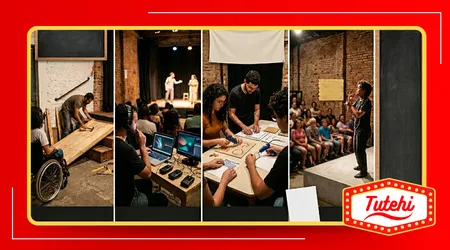
Independent groups have proven that lack of funding does not justify neglect. "Creative accessibility" incorporates sign language interpretation into dramatic text, making the interpreter an active character on stage.
Partnerships with universities are a smart approach. Translation students find in theatre a very rich field of internship, while companies guarantee technical support without inflating production costs.
The strategic use of QR codes in print programs directs the viewer to pre-recorded audio descriptions of costumes and sets.
It's a simple, inexpensive, and extremely functional solution for alternative spaces.
Small adjustments to the stage lighting can make lip reading easier without spoiling the aesthetics of the performance. Often, what's lacking isn't money, but a minimum sensitivity to the comfort of others.
Expand the debate on accessibility This is vital for the "underground" scene. It is in these spaces of experimentation that the most organic solutions are born, far from institutional constraints and close to the reality of the streets.
Training the reception staff to deal with diversity is the first step. A welcoming environment with contrasting signage already solves half the problems for those with low vision.
+ National scene and the importance of the Cenym Award for Brazilian theater.
Strategies for audience development and social inclusion.
Having the ramp and the interpreter is only half the job. The real challenge is inviting that audience to occupy the theater, feeling that those stories also belong to their existence.
Building an audience requires specific communication channels. It's useless to have an accessible play if the show's social media doesn't have alternative text for images or videos without captions.
Many companies are already reaping the benefits of offering free workshops for people with disabilities. When the spectator shares the stage as a creator, the barrier of fear of occupying the space disappears.
This exchange revitalizes theatrical direction. The perspective of someone who perceives the world through other senses forces the director to move beyond the commonplace and explore new aesthetic and sensory languages.
Keep alive debate on accessibility It's about ensuring that Brazilian theater doesn't become a museum of exclusive customs. Art is only complete when it manages to be a meeting place for different people.
The barometer for a successful season in 2026 has changed. It's no longer just about profit, but about the diversity of people who crossed the ticket screen and felt, for the first time, seen.
To understand the global parameters that guide these changes, it is worth checking the guidelines of UNESCO on Cultural Diversity, which position access as a pillar of social development.
Closing
The path to full accessibility is an ongoing process, but the scenario for 2026 points to an unprecedented level of maturity.
Brazilian theater is finally learning that inclusion is not a favor, but a condition for its own relevance.
The compromise between technology, legislation, and artistic sensibility is what will allow the curtains to open for everyone.
When theater becomes accessible, it doesn't just gain a ramp; it gains soul and purpose.
Frequently Asked Questions (FAQ)
1. What characterizes communication accessibility?
These are the resources that allow for a full understanding of the content, going beyond the physical space and focusing on the translation of meanings (Brazilian Sign Language, audio description, and subtitles).
2. Should unconventional spaces be accessible?
Without a doubt. The right to culture is independent of the performance venue; producers must adapt the environment to ensure that no one is barred by the architecture.
3. Does current legislation provide for penalties for non-compliance?
Yes, the Brazilian Inclusion Law establishes fines and can prevent production companies that do not comply with accessibility standards from receiving public funding.
4. How can the public demand these resources?
Through the theaters' customer service channels and, in cases of negligence, via consumer protection agencies or the Public Prosecutor's Office.
5. Does audio description hinder those who are not visually impaired?
No. In closed audio description systems, only those using headphones hear the narration, without interfering with the experience of the rest of the audience.